
Subscriptions, Subscriptions, Subscriptions! - CardsFTW #130
It’s not news that most people feel overwhelmed by subscriptions. You might even have a subscription to a tool to manage your subscriptions. We all spend a lot on recurring charges, from coffee beans to streaming, home services, and credit card fees. (Do credit card fees count as subscriptions? Maybe, but I know I have four of them, and I need them all!)
The list goes on and on. We all know how easy it is to sign up for a new subscription service or, even worse, sign up for a “free trial” only to get caught up in automatic renewals inadvertently. I challenge you to write down the number of subscriptions you think you currently have and then take inventory and see how accurate you were.
We are all products of our environment and live in an environment where (for better or worse) VC and PE investors love recurring revenue models. So, businesses naturally push subscriptions onto us, the end consumers.
How Much Are We Spending?
The average American spends about $220 a month on subscription services. For comparison, car insurance costs about $199 per month, and groceries for a family of two are about $235 monthly.
The problem with subscriptions is that our psychology is often used against us. Either you hang on to a subscription because you swear you’ll use it soon, or you just forget you have it.
Then, of course, there are the free trials and the fun challenge of seeing if you remember to cancel them or if they turn into subscriptions. I spent one free week diligently studying Spanish on Duolingo but never touched it again despite continuing to pay for it. The even harder-to-catch ones are those with longer trial periods. I signed up for 3 months of Kindle Unlimited and didn’t even notice that I was getting charged after–I didn’t need to put in my card information for that one because it was already attached to my Amazon account.
We are also unlikely to cancel subscriptions under $20 per month because they feel like such a small portion of our spending pie. It’s easy to justify the price when we’re aware of it, and it’s even easier to forget about such a small amount when it’s automatically being charged to our cards (hey, it’s about the price of an average meal these days).
The difficulty of keeping tabs on our subscriptions can cause us to drastically underestimate how much we spend each month. And don’t even get me started on the year-long subscriptions; you pay for those once, forget about it, and then suddenly, you’re out a chunk of change, and you missed the cancellation window by 3 months.
C+R Research stated:
On average, $86 per month was the initial amount consumers estimated they spent on subscription services.
But upon closer look at their itemized expenses, the average monthly spend for consumers was more than 2.5 times the amount they thought at $219 – a whopping $133 higher than their original estimate.
It’s the Economy, Stupid. But is it?
After a years-long inflationary streak, consumers feel squeezed and want to spend less on discretionary items. A study by Deloitte estimated monthly spending intentions for non-essential purchases in August were down 18.6% from 2021. In July 2024, American consumers reported spending 8.8% less than in July 2023.
The macroeconomic environment suggests consumers want to spend less on discretionary items such as a Netflix subscription. But are they? Companies like Netflix may be rather recession-resistant as consumers seek to lean more heavily on in-home entertainment vs. travel or shopping for luxury goods. A study by McKinsey reported that while consumers expected to spend less on items such as furniture, jewelry, and travel, a whopping 80% expected to pay the same amount or more on in-home entertainment and food delivery apps.
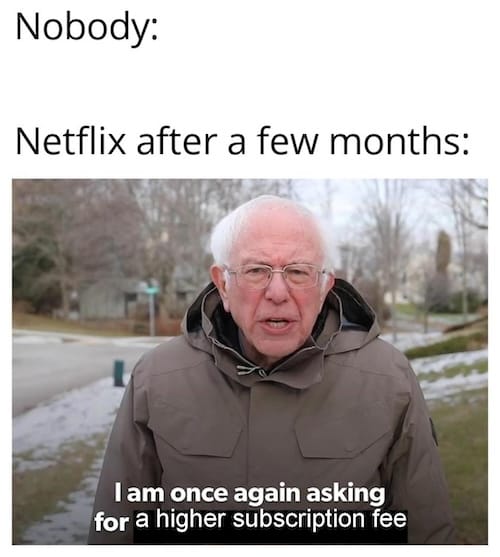
Netflix stock price recently jumped from $687.59 on October 17 to $763.89 on October 18 due to unexpectedly strong results and growth despite the precarious macroeconomic environment. This may indicate that consumers have a preference in terms of which subscriptions they’re willing to maintain vs. forego when times get tough.
Click to Cancel
Regardless of how consumers feel about their apparently beloved Netflix accounts, we know that they are also seeking increased control over their finances. However, control is difficult when canceling subscriptions is 10 times more difficult than signing up.
Who can forget the viral 3-hour Comcast call that garnered over 1.4 million views? But that was in 2014, and the Federal Trade Commission (as well as the people) have had enough.
As of Wednesday, October 16, the FTC announced that companies must make it as easy to cancel subscriptions as it is to sign up for a service.
Companies must now obtain consumers’ consent before charging for memberships, auto-renewals, and programs linked to free trial offers. They must also notify customers when those free trials end.
Enter ScribeUp
The recent FTC ruling could be a huge boon for companies like ScribeUp*, which is committed to helping consumers efficiently manage and cancel their subscriptions.

In addition to offering their services to banks and fintech apps that wish to provide value-added subscription management features to their users, they may be able to offer their services to brands that don’t want to run into trouble with the FTC. For example, Netflix may encourage its customers to sign up for its service with specific banks that have ScribeUp features embedded so as to add an extra layer of protection against the FTC.
What I love about ScribeUp is that they seem to be living up to their mission of minimizing rather than adding to people’s subscriptions list. They could have gone the ironic route of asking individuals to pay for ScribeUp as a service to manage subscriptions. However, by partnering with people’s existing banks and meeting people where they already are (their banking apps), they’re helping people minimize subscriptions without becoming yet another pesky subscription service themselves.
CardsFTW
CardsFTW, released weekly on Wednesdays, offers insights and analysis on new credit and debit card industry products for consumers and providers. CardsFTW is authored and published by Matthew Goldman and the team at Totavi, a boutique consulting firm specializing in fintech product management & marketing. We bring real operational experience that varies from the earliest days of a startup to high-growth phases and public company leadership. Visit www.totavi.com to learn more.
Interested in reaching our audience? You can sponsor CardsFTW.
*Indicates a company with which Totavi has a financial relationship.