
It’s All About Redemption - CardsFTW #144
Plus, Mastercard One
Mastercard’s One Credential
Following last year’s news of Visa Flex (see CardsFTW #107), Mastercard announced its version: Mastercard One Credential, a “single, digitally connected credential offering consumers a choice of multiple payment methods, configured to their specific preferences—all from the palm of their hand.”
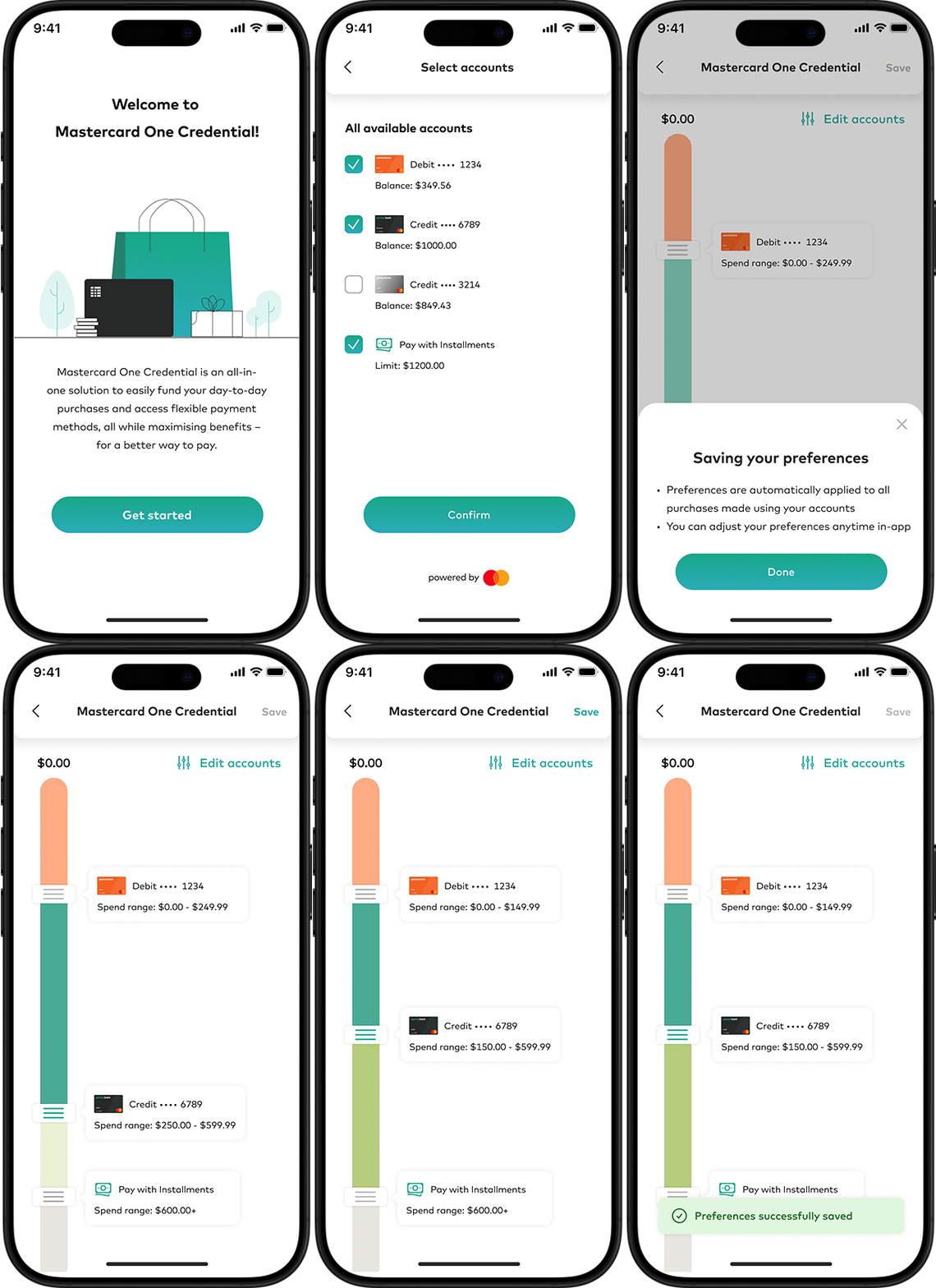
Call me skeptical, but I continue to believe most consumers bank with more than one financial institution and more than one network. As a result, these all-in-one solutions are doomed from the start because they are set up as single issuers and single networks. For my full story on universal card products, take a look at issue 107.
Rewards Redemption
Of the many fintech products we help people build at Totavi, rewards-based cards are certainly our specialty. Often, when we first speak to people about new rewards card products, they are focused on new earning categories (think about the excitement for Bilt Mastercard around earning points on rental payments).
That’s great, but rewards are only as good as what you can use them for. Points that are complicated or hard to use will lose the interest of consumers. Certainly, there is a segment of the population (and a segment of card products) that will focus on cashback, but many consumers love rewards. Earning points can lead to surprise and delight with unique ways to redeem and the psychological permission to spend money on yourself.
When I built the Grand Reserve World Mastercard, the redemption that made the entire product sing was redeeming points for amazing and rare bottles of wine. Sure, you could buy all sorts of wine with our points (or other things like wine glasses, etc.), but what excited our users was the idea that they could spend 100,000 points to get a rare and hard-to-find bottle. They might never have spent $900 on a bottle, but they were willing to spend 100,000 points on one.
There are many corollaries to this: first-class tickets, upgraded hotel rooms, and more are luxuries that average people (e.g., not high-net-worth consumers) want to indulge in, but given $1,000 in cashback, they will pay down debt or pay a bill rather than go for a luxury product. Rewards points give you permission to treat yourself.
When you redeem your points, you should be as happy as possible with the loyalty program, your card, and your membership. However, I keep finding that the redemption process is increasingly frustrating and confusing. Programs are most vulnerable to churn at the point of redemption (if I spend all of my points and have a low balance, I might as well leave), which is a huge opportunity to win customers in the long term.
I have recently been planning some travel and experiencing frustration and a lack of consistency in redemption, which is making me question some of my loyalty and card choices. Let’s look at two real-life examples.
Miles are Meaningless
I have collected a lot of miles and points across flexible programs like Chase Ultimate Rewards and American Express Membership points, as well as direct programs (e.g., Delta SkyMiles and Marriott Bonvoy points). I need to fly to Canada for a family event, and my experience with the value of these points was surprising.
Many bloggers and analysts are huge fans of Amex’s Membership Rewards points, giving them high value (up to 2.0 cents per point). Delta has a strong reputation for being the best US airline experience. So, I looked into a flight and a splurge on first class.

For a single round-trip on the same dates, I found wild variations in cost:
- Cash via Amex Travel = $941.50
- Points via Amex Travel = 94,150 (e.g., 1 point is worth $0.01)
- Cash via Chase Travel = $836.55
- Points via Chase Travel = 55,771 (e.g., 1 point is worth $0.015)
- Delta Miles on Delta = 231,000 miles (e.g., vs. the lowest cash cost of $0.004 per point)
If I used Delta SkyMiles, I would have the worst redemption value.
If I used Chase points from a bank that is without direct association with Delta, I get the highest value. (Plus, since it looks like I paid cash on Delta's side, I’ll earn more miles.)
What is going on here?
This did not make me want to get a Delta credit card.
Redemption is Hard
It’s not all about the point values, however. I also recently made a points reservation at Marriott. Rest in peace, Starwood. I have Lifetime Gold Status at Marriott, with 755 lifetime nights and 7 years as a Platinum Elite member. (Three more years, and I can be Platinum Elite!) I have been a co-brand card-carrying Marriott/Starwood member for 21 years.
And yet, I’m thinking about switching.
Starwood was so great because there were no blackout dates. You could reserve different room types (by paying more points), and you were never penalized for redemptions.
Marriott is not like that. I have a hard time finding places to stay on points. Points feel devalued. I recently got dinged 2,000 extra points to have two people in a single room (hotels are full of it to charge extra this way; I mean, come on).

Last year, I spent most of my Marriott points on a big vacation. I am second-guessing my plans to stay with them. If I leave, so goes my credit card. Marriot’s service is also getting worse–everything about the website is clunky, and some features (like adding a second name to your room on a points reservation) cannot be done online. However, calling in requires asking the IVR for an agent for five minutes. Ugh.
Win at Redemption
While earning rates are important, customers really care about what those points get them in the end. They need to be priceless, to quote our friends at Mastercard.
Cardholders will make mathematically irrational earning decisions (e.g., move a card to the top of the wallet without a top earning rate) if the redemption is exciting. The reason could be the possibility of earnings growing (e.g., with crypto or investment cashback, your rewards can grow), or it could be that redemptions are fun, indulgent, or even unique (e.g., you can only get access to an experience via points).
If you want to build a winning program, focus on that redemption experience. Congratulate your customers on their outcome. Give them a reason to stick around (such as a redemption boost) and make sure you continue to earn their loyalty.
CardsFTW
CardsFTW, released weekly on Wednesdays, offers insights and analysis on new credit and debit card industry products for consumers and providers. CardsFTW is authored and published by Matthew Goldman and the team at Totavi, a boutique consulting firm specializing in fintech product management & marketing. We bring real operational experience that varies from the earliest days of a startup to high-growth phases and public company leadership. Visit www.totavi.com to learn more.
Interested in reaching our audience? You can sponsor CardsFTW.