
Evolve’s Impact on the Fintech Industry - CardsFTW #114
Plus, Target stops taking checks, and Expedia launches a new credit card.
I've generally avoided writing about Synapse's collapse and the programs on top of it, but it's time to cover what has been going on in FinTech, as so many card programs are affected by this.
Financial technology startups build the most innovative card products on the market. However, these startups are not banks and need partner (or sponsor) banks to operate. The challenges in finding a partner bank are greater than ever.
In Canada and Europe, companies can acquire different licenses or become direct network members without being banks, enabling them to issue their cards. In the United States, however, issuing a card on a major payment network such as American Express, MasterCard, Visa, or Discover requires a registered financial depository institution. One must be a bank to directly access the network as a card issuer for debit and credit. Consequently, fintech companies with new card ideas must partner with a bank. Depending on who you ask, there are 70-100 active partner banks today.
These banks vary in their services—some handle credit, while others do not. Finding a bank that offers consumer credit card issuing is particularly hard because it is the most regulated portion of the industry, making it an area many banks avoid. For the past six or seven years, Evolve Bank and Trust of Arkansas has been known for its willingness to say yes to new programs. However, they can’t say yes to anything anymore due to the recent intense scrutiny. (And I’m not sure anyone wants to work with them.)
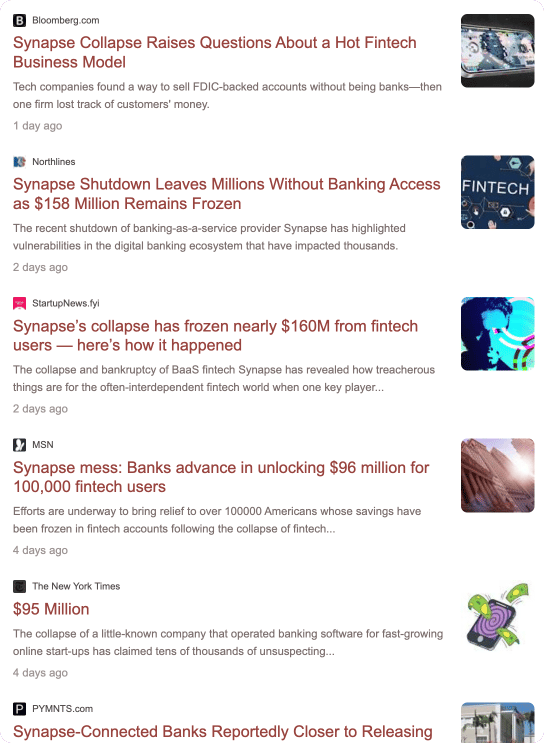
For those of you who haven’t been following along, Synapse, Evolve's largest fintech partner for sub-programs, recently went bankrupt. Although Evolve and Synapse were already in the process of disconnecting parts of the relationship, the bankruptcy led to significant scrutiny over missing funds and the harm they have caused to many consumers in the process. (Current estimates are missing over $50M in funds.) Under a recent consent order, Federal regulators found multiple deficiencies in Evolve's operations, preventing them from taking on new projects from any partners.
Other programs, whether operating independently or with Evolve's assistance, are now distancing themselves from the bank. These incidents leave the industry with one less bank willing to support new initiatives. As some other writers have acknowledged, maybe Evolve's willingness to say yes to many programs was a feature and not a bug, although it led to their recent situation. Evolve likely agreed to some projects they shouldn't have and grew faster than they were prepared for. Many fintechs overlooked these risks and were eager to get their programs approved. Now, numerous providers, including those working with other banks, are in a bind.
It isn’t only the programs that worked with Evolve that are affected–everyone is impacted. There is an industry-wide reaction to these events. Consider a platform partnered with BankX, a bank that only manages a few programs but aims to grow. With Evolve's exit, many new programs will approach BankX, straining its resources. While this potential growth is beneficial in the long term, BankX is also cautious due to increased regulatory scrutiny (see Fed Chairman Jerome Powell’s recent questioning of the topic in the Senate).
This situation, wherein programs seek new homes and banks are newly cautious, is creating a freeze, causing everything in fintech to slow down significantly. Programs without existing bank approvals find it difficult to start new projects, while those with approvals struggle to make changes. Evolve sponsors many large programs, with household names such as Affirm, which are undoubtedly affected in their ability to iterate on their offerings. Migrating away from Evolve is challenging and slow, exacerbating the overall freeze in the industry.
For anyone considering building a card program, it's time to reevaluate your approach. Building a program from the ground up with a bank will be increasingly difficult. Collaborating with a program manager with existing bank relationships is much easier. You'll need a much more robust marketing plan and other essential components ready to succeed in this environment, but a program manager can get you a big part of the way to issuing cards.
Starting a card program with $2 million in capital was feasible in the past. Twelve years ago, I launched a program with just $1 million. Banks are looking for $5 to $10 million or more today. They expect fintech companies to have more customers, capital, and strong compliance measures before approval.
Some founders might think their great idea deserves a chance, but unfortunately, no one deserves that. You’re going to need a lot more. From a startup perspective, securing the necessary funds can be a challenge. Whether you need to convince venture capitalists or find alternative ways to validate your concept, you must know the new banking realities. Before launching a card, exploring options like loyalty programs, card-linked offers, or other business solutions might be necessary.
The end of 2022 saw challenges with the crypto freeze, and companies started to go under, sell, or restructure at the beginning of 2023. Recent months have only compounded these difficulties.
We also saw Evolve recently experience a significant security incident in which private Evolve email and data were stolen, raising questions about security protocols at the bank. These security expectations impact fintechs looking to launch new programs. Banks now require comprehensive security plans, SOC 2 certification, PCI compliance, and robust platform security. While tools like Thoropass have made obtaining PCI or SOC 2 certification easier and more affordable, it remains crucial to implement these measures correctly.
The reality is that the bar for innovation is rising, and progress is slowing. It is unfortunate that major institutions like Chase are simultaneously threatening to increase fees while the companies that innovate for customers face new hurdles. This period may feel like winter, but companies can navigate through it with the right resources. As a proof point on this, today, fintech card startup Aven announced a monster $142MM investment round for its credit card that is secured by your home equity.
Good ideas will prevail, and the increased diligence, scrutiny, and capital requirements will ultimately lead to stronger companies.
Target Says No to Checks

Recently, Target announced that it will stop accepting personal checks. Who knew Target still accepted personal checks? This move highlights a broader trend where large companies are steering customers towards cards and digital payments despite checks theoretically having lower costs. In reality, checks come with higher risks and are slower to process. While businesses often debate interchange costs, they are increasingly phasing out checks. Personally, I haven't seen anyone use a check at a retail point of sale for quite some time, although they are still prevalent in the U.S.
Expedia's New Card

Lastly, this week, Wells Fargo launched a new card with Expedia for its OneKey Rewards program. OneKey is an independent rewards system for hotels and airlines when booked on Expedia properties. The OneKey card functions primarily as a cashback card since the points operate more like cash.
Two cards are available: the OneKey zero annual fee card, which earns 3% cashback at Expedia, Hotels.com, Vrbo, gas stations, grocery stores, and dining, and 1.5% everywhere else. This card also offers a strong signup bonus. The OneKey Plus card has a $99 annual fee but provides a $100 annual credit, effectively making it free if used, and comes with a higher signup bonus. These cards are a strong offering for those who frequently use Vrbo or book through Expedia. Unlike traditional airlines, these programs lack direct inventory to offer as rewards. However, seeing more vacation options is nice, especially for those who prefer not to commit to a single brand.
CardsFTW
CardsFTW, released weekly on Wednesdays, offers insights and analysis on new credit and debit card industry products for consumers and providers. CardsFTW is authored and published by Matthew Goldman and the team at Totavi, a boutique consulting firm specializing in fintech product management & marketing. We bring real operational experience that varies from the earliest days of a startup to high-growth phases and public company leadership. Visit www.totavi.com to learn more.
Interested in reaching our audience? You can sponsor CardsFTW.
*Indicates a company with which Totavi has a financial relationship.