
Credit Card Branding Drives APRs - CardsFTW #154
Plus, usury laws and legal cases allow them to charge a lot, regardless of state law
APR Alpha: How Credit Card Brands Monetize Marketing Muscle
You might think the 23% average APR on credit cards is about covering risk or recouping generous rewards programs. However, a new Federal Reserve study[1] shows something more revealing: marketing is the secret weapon that lets issuers charge higher rates than risk alone would suggest. Even after subtracting expected defaults and accounting for interchange-funded rewards, banks still earn a 6.8% return on assets (ROA) from lending, four times the industry average. And that outsized return? It scales with default risk. A 600 FICO borrower generates an 11% ROA; a superprime 850 borrower, 5%.
The study finds that the traditional culprits—charge-offs and rewards—don’t fully explain this spread. Default-adjusted APRs (interest minus losses) still average 8.8% across the board. Net interchange income is slightly positive and doesn’t plug the gap either. What does? Operating expenses, especially marketing. Credit card banks spend 4–5% of assets on operating costs, with 1–2% dedicated to marketing, 10x that of typical banks. This investment gives them pricing power, or as the authors put it, a “franchise.” The result is that banks charge same-FICO borrowers more with higher operating spending.
Capital One and Amex didn’t become household names by accident—they spend billions on branding to stay top of wallet. That spend allows them to maintain spreads well above what corporate bonds of equivalent credit risk offer. The study finds that, for most FICO tiers, card APRs price is similar (and sometimes higher) to the risk premium of high-yield corporate debt. And for the riskiest borrowers (think sub-660 FICO), credit cards out-yield even CCC-rated bonds by about 300bps. That’s marketing: turning revolving credit into an equity-like return stream.
The authors also estimate a “credit card alpha” of 1.17–1.44% after adjusting for risk. That is, even after backing out compensation for undiversifiable default risk (which they price via a single-factor model à la Fama-MacBeth), credit card lending is just more profitable than anything else in the bank. Think about that: in a commoditized, regulated, near-zero-margin industry, credit cards remain a golden goose. But it’s not the card product that’s magical—it’s the consumer behavior and the brand attachment marketing buys.
So, the next time you see a stadium named after a card issuer or get a metal card ad during the Super Bowl, remember: it’s not just about customer acquisition. It’s about sustaining the margin structure that keeps credit card APRs high, sticky, and oddly beloved.

How Credit Cards Escaped Usury Laws
It wasn’t always like this, with 23% and higher APRs. Usury laws have existed since colonial America, originally meant to protect borrowers from exorbitant interest rates. However, the current reality of credit card APRs, often exceeding 20 or even 30 percent, seems detached from that intent. Today, major credit card issuers operate in a regulatory landscape where state-level interest rate caps are largely irrelevant. This transformation didn't happen by accident: It results from a few pivotal legal decisions, aggressive bank strategies, and the emergence of new financial centers in places like Sioux Falls, South Dakota.
A Legacy of State Usury Laws
For much of U.S. history, usury laws were enforced at the state level. These laws typically limited the interest a lender could charge, often capping rates around 6 to 10 percent. States had the authority to define what was excessive, and interest rate limits varied across jurisdictions. Banks were generally chartered by states and bound to operate under those rules.
This created a fragmented system where a borrower in New York might be protected by strict usury limits, while a borrower in another state might not. However, this patchwork system remained intact for much of the 20th century because banks generally only served local markets. National interest rate differences mattered less when your community bank wasn’t issuing credit cards to people in twenty other states.
The Marquette Decision: Breaking the Mold
The 1978 Supreme Court ruling in Marquette National Bank of Minneapolis v. First of Omaha Service Corp changed everything. The case centered on whether a Nebraska-based bank could charge a Minnesota borrower interest rates that were legal in Nebraska but would violate Minnesota’s usury laws.
The Court unanimously sided with First of Omaha, holding that under the National Bank Act of 1864, a national bank could charge the interest rate allowed in the state where it was located, not where the borrower resided. This decision effectively nullified state-level usury protections for out-of-state borrowers. As long as the bank operated under a national charter, it could "export" its home state’s interest rates nationwide.
This ruling cracked open the door, and banks quickly ran through it.
The Strategic Bank Migration
By the late 1970s, inflation had generally driven up interest rates, and states with strict caps were becoming less profitable for credit products. At the same time, the Supreme Court's Marquette decision created an incentive for banks to seek out states with the most favorable regulatory environments.
South Dakota was the first to seize the opportunity. In 1980, then-Governor Bill Janklow passed legislation removing interest rate caps and personally courted Citibank, which at the time was facing losses on its credit card portfolio due to New York's usury limits.
Citibank moved its credit card operations to Sioux Falls in 1981. Delaware followed the South Dakota model shortly thereafter, with similar deregulatory moves attracting other major issuers. These states became the nucleus of a new financial model: banks would incorporate where interest rate laws were lenient and issue credit nationwide.
How Exportation Works in Practice
If you live in California but hold a credit card issued by a bank based in South Dakota, the terms of your account are governed by South Dakota law. This includes the permissible interest rate, which, in South Dakota, is effectively unlimited as long as it’s disclosed.
Banks routinely cite the Marquette decision to justify this arrangement. As long as the issuing bank is nationally chartered and located in a state that permits high rates, it can apply those terms to any borrower in the U.S. This is why state usury laws have been largely powerless in curbing high APRs on credit cards.
The Madden Case and Its Limits
The principle of rate exportation faced a partial test in Madden v. Midland Funding (2015), a case in which a debt buyer argued it could continue to charge the same high rates as the national bank that originally issued the debt. The Second Circuit Court disagreed, holding that non-bank entities purchasing debt were not entitled to the same rate exportation privileges.
The Madden ruling sowed uncertainty in the secondary debt market, prompting calls for legislative or regulatory clarification. Still, the core principle—that nationally chartered banks can export rates—remains untouched for banks themselves. The Office of the Comptroller of the Currency (OCC) and the FDIC have since taken steps to reaffirm this bank-centric authority.
Why Certain States and Cities Became Hubs
South Dakota and Delaware are small states with outsized roles in consumer finance. Their appeal isn’t just low regulation. These states also provide:
- Speedy legislative responses to industry needs
- Political climates favorable to financial services
- Tax incentives and business-friendly courts
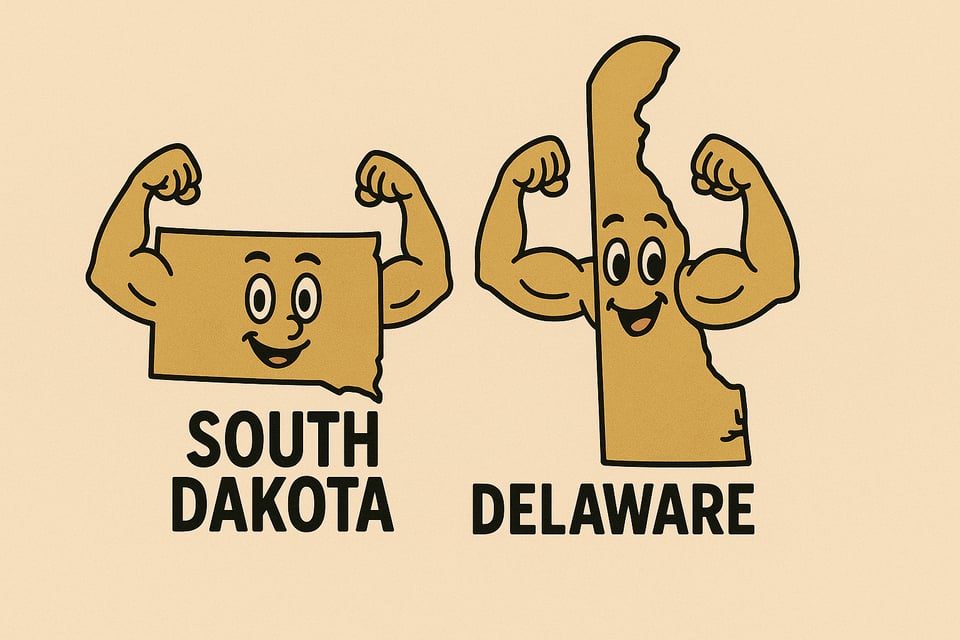
The influx of credit card operations transformed cities like Sioux Falls and Wilmington into financial hubs. These weren't historical banking centers like New York or Chicago but offered regulatory arbitrage that legacy centers couldn’t match.
Even today, Sioux Falls remains home to the credit card divisions of Citibank and Wells Fargo. Meanwhile, JPMorgan Chase, Barclays, and Capital One have substantial operations in Delaware. (This is also the only reason I’ve had to take a business trip to Delaware, which involved a flight to Philadelphia, a train to Delaware, and two nights at a hotel, all just for a 90-minute meeting with a big bank.)
The Consumer Impact
While banks gain flexibility and profits, consumers are exposed to potentially high costs. According to the Federal Reserve, the average credit card APR for interest-accruing accounts now exceeds 22 percent.[2] For subprime borrowers, rates can surpass 30 percent.
Defenders argue that this reflects risk-based pricing and the need to cover losses from charge-offs. Critics counter that this environment enables predatory lending and reduces price competition.
Usury caps in high-regulation states like New York or Massachusetts are rendered irrelevant, even as policymakers seek ways to curb high-interest debt. Attempts to reintroduce federal usury caps have routinely stalled in Congress.
Legislative and Regulatory Responses
Over the past two decades, there have been multiple efforts to rein in rate exportation:
- The Credit CARD Act of 2009 introduced transparency and timing rules but didn’t impose rate caps.
- Some Democratic lawmakers have proposed national interest rate limits (e.g., 15 to 36 percent) but faced opposition from industry groups and political hurdles.
- Recent discussions around a national usury cap have gained momentum in the context of broader consumer protection debates, but practical implementation remains elusive.
Without federal action, the Marquette decision stands as a bulwark against state-level consumer protections on interest rates.
Looking Ahead
Technological change has made geographic location less relevant for customer acquisition or servicing, but state laws still anchor the legal structure of credit card contracts. As long as rate exportation remains legal, the economic logic for banks to domicile in favorable jurisdictions persists.
However, political pressure may increase. Rising consumer debt levels, the growth of buy-now-pay-later models, and a renewed focus on financial inclusion are all spurring debate about how consumer credit is priced.
For now, though, the system endures: a Nebraska bank can lend to a New Yorker under Nebraska law. And so long as that principle holds, South Dakota and Delaware will keep their unlikely prominence in the financial world.
[1] Itamar Drechsler, Hyeyoon Jung, Weiyu Peng, Dominik Supera, and Guanyu Zhou, “Why Are Credit Card Rates So High?,” Federal Reserve Bank of New York Liberty Street Economics, March 31, 2025. ↩︎
[2] Federal Reserve, G.19 Consumer Credit Report, March 2025. ↩︎
CardsFTW
CardsFTW, released weekly on Wednesdays, offers insights and analysis on new credit and debit card industry products for consumers and providers. CardsFTW is authored and published by Matthew Goldman and the team at Totavi, a boutique consulting firm specializing in fintech product management & marketing. We bring real operational experience that varies from the earliest days of a startup to high-growth phases and public company leadership. Visit www.totavi.com to learn more.
Interested in reaching our audience? You can sponsor CardsFTW